

Valencia Best Places: A Community-Driven Tourism Model
Valencia | Valencian countryside | Locally sourced | Sustainability | Mediterranean cuisine | Seasonal produce | Local area and experience | From farm to table | Restoration of estates and heritage | Valencian citrus fruits | Edible flowers | Sustainable tourism
Valencia is a region that is experienced through its land. The orchards, the sea and the light define its landscape and also shape its approach to life, gastronomy and the passing of time. Here, the focus is on local produce, seasonality and provenance: fields that remain in use, varieties that have been
preserved from generation to generation, and a culture that has always looked to what grows around it.
The Valencia Best Places project is built on this foundation, offering a way of understanding the restaurant industry that connects directly with the region and is based on three pillars: the produce, the setting and the experience. Each venue forms part of that narrative. From the Albufera to the city centre, via the orchards and historic farmhouses, the
projects blend into their surroundings and reinterpret them through a contemporary lens, without losing their essence.
Gastronomy thus becomes a meeting point between tradition and evolution. What is grown in the fields reaches the kitchen and, from there, is transformed into experiences that bring the customer closer to the origin of it all. At the same time, the project embodies a responsible vision, where sustainability translates into concrete decisions: locally sourced produce, the restoration of estates and respect for the environment, alongside an approach that seeks to generate a positive impact on the local area.
This creates an ecosystem where everything is connected: the orchards, the kitchen, the spaces and the people. Valencia, savoured from within.
1.VISION AND SUSTAINABILITY
Valencia is light, orchards and the sea. A region where produce is grown just a few kilometres from the table and where cuisine has always been directly linked to the landscape. The group develops its projects based on this connection, viewing gastronomy as a natural extension of the environment. Each venue captures something of the place where it stands—the Albufera, the orchards, the Mediterranean or the city—and transforms it into an experience that brings the source closer to the plate and highlights what grows here.
On this basis, a model is built where sustainability, the local area and gastronomy move in the same direction. The commitment to the environment is integrated into every decision, from the selection of produce to the way the venues are run, creating a system that focuses on three key areas: the produce and its origin, the people involved in the project, and the impact on the environment.
The commitment to local suppliers, responsible resource management, energy efficiency and carbon footprint measurement are part of day-to-day operations, consolidating a way of working aligned with the Sustainable Development Goals. This commitment has been recognised at group level with the S for Sustainable Tourism, whilst various venues have been awarded the Valencia Verde distinction, promoted by Visit València, which highlights the commitment to the principles of the European Green Capital and the development of a more environmentally friendly model.
In this context, Maravella is joining the MISEA project, an initiative led by SEGITTUR and the Ministry of Industry and Tourism that promotes sustainable innovation in the tourism sector. Through this partnership, a line of work focused on local produce, regional ingredients and authentic experiences is being strengthened, connecting visitors with the region from its very roots and positioning gastronomy as a key tool for interpreting the Valencian landscape.
2.ORCHARD, COUNTRYSIDE AND LOCAL PRODUCE
The group operates through a network of venues and estates that bring together gastronomy, the local area and the dining experience. Restaurants in the centre of Valencia, seaside locations, urban gardens and historic farmhouses form part of a single ecosystem that stretches from the city to the surrounding countryside and natural environment.
This network is complemented by the group’s own agricultural base, covering over 50 hectares of cultivated land, with Kitchen Garden in production, citrus groves, fruit trees and estates where the produce destined for the kitchen is processed directly on site. Venues such as Maravella and Masía El Pinar allow us to connect the source with the dining experience, integrating cultivation, gastronomy and research into a single journey.
The group thus combines various activities: catering, agricultural production, heritage restoration and the development of projects linked to sustainability and culinary innovation. All of this is organised under a single vision, where each venue offers a distinct perspective on the Valencian region and helps to build a cohesive and constantly evolving concept.
MARAVELLA — Kitchen Garden AND HOME-GROWN PRODUCE
At Maravella, the Kitchen Garden is an integral part of the dining experience and is situated just a few metres from the table, allowing us to prepare the produce at its peak. It is cultivated according to organic farming criteria, in collaboration with Saifresh, a project specialising in sustainable production recognised with the EU Organic Awards 2024 and the BBVA Award for
sustainable producers in 2021, which provides technical expertise, the revival of local varieties and an agricultural approach aligned with the local area.
The Kitchen Garden is conceived as a living space in constant evolution, where produce is grown and harvested according to the season, directly shaping the culinary offering.
In the summer season, the focus is on:
- native tomatoes from the Valencian Kitchen Garden
- Italian peppers
- fresh seasonal Kitchen Garden
In the winter season, the Kitchen Garden transforms with:
- artichokes
- leeks
- potatoes
- calçots
Added to this is a permanent agricultural base featuring:
- orange trees (various varieties)
- lemon trees
- kumquat trees
- unique varieties such as citrus caviar and the elongated orange (Fully type)
This model allows us to bring produce from the garden to the table as locally sourced and organic produce, where seasonality defines the menu and the origin is visible and genuine. Many of the ingredients that reach the plate have been grown just a few metres away, with no middlemen, reinforcing a direct connection between the fields, the kitchen and the customer.
At Maravella, the orchard defines the cuisine and also gives meaning to the space.
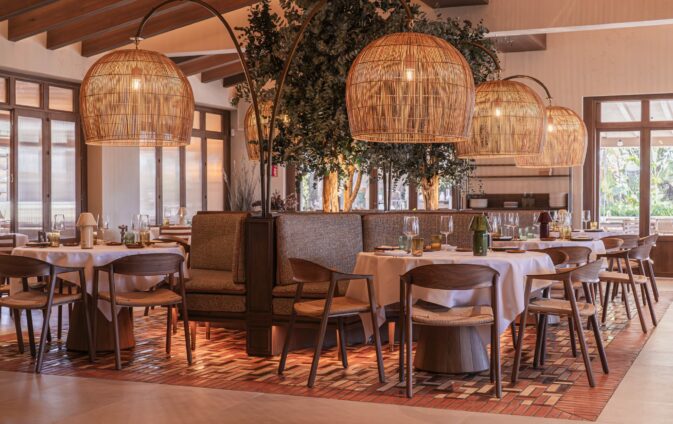
The project takes the form of a contemporary farmhouse covering over 3,000 square metres, completely renovated by the Janfri & Ranchal studio, where the architecture is designed in direct dialogue with the surroundings. Natural materials, vegetation, water and natural light enhance the experience and reinforce the connection with the orchard landscape.
The main dining room, which can seat between 150 and 200 guests, opens out onto the outdoors and is complemented by various private dining rooms, each with its own terrace. This layout ensures that every space maintains a constant relationship with the surroundings, creating an experience that shifts between the intimate and the communal without losing its connection to the land.
The Kitchen Garden, clearly visible and ever-present, accompanies visitors throughout the tour.
MASÍA EL PINAR — LANDSCAPE, CULTIVATION AND INNOVATION
Masía El Pinar represents a broader and deeper dimension of the project: a space where the landscape is experienced from its very origins and where the countryside shapes the project’s evolution.
Set in a natural environment linked to the Sierra Calderona, the estate forms part of an agricultural ecosystem that extends alongside other sites belonging to the group, such as San Antonio de Pádua, creating a continuous whole where landscape, cultivation and heritage coexist in harmony.
Within this setting, the estate cultivates its own fields, featuring almond and loquat trees, potatoes and a seasonal Kitchen Garden, as well as orange and other citrus trees, and produces olive oil from olives grown on the estate. This agricultural base is integrated into a landscape that combines productive areas with areas of high environmental value.
The estate preserves historic pine forests and protected monumental trees, including notable specimens of Canadian pine and hackberry trees over 200 years old, creating a unique natural environment. The entire estate lies within an area linked to the protected environment of the Sierra Calderona Natural Park, reinforcing our commitment to conservation, respect for the environment and responsible stewardship of the land.
Masía El Pinar is evolving as a space of continuous development: here, we are promoting ‘Sanamente’, an R&D project that brings together gastronomy, health and ancestral knowledge. The estate serves as a living laboratory where new culinary and functional applications of local plants, flowers and produce are explored, reviving traditional knowledge and adapting it to a contemporary perspective.
The proximity to San Antonio de Padua reinforces this vision, expanding production capacity and consolidating a model where different estates operate as a connected system, capable of sustaining both agricultural production and the future development of the project.
3.GASTRONOMIC RESEARCH AND HEALTH
As part of the group’s strategy, Masía El Pinar serves as the hub for a specific line of work linked to gastronomic research, the local area and health.
In this context, a specialised multidisciplinary team is working on-site at the estate to develop a unique project.
On the one hand, research is being conducted focusing on the use of edible plants and flowers, analysing their properties, their behaviour in the kitchen and their potential within a gastronomy connected to the environment. The team works with species found on
the estate and in the Valencian landscape —such as marigold, dandelion, wild thyme and orange blossom— integrating them into dishes and developing new culinary applications. This approach draws on traditional knowledge, where flowers have long been part of both the diet and practices linked to well-being.
On the other hand, this line of work forms part of a broader framework: Sanamente.
Sanamente was created as a space for reconnection, health and ancestral organic gastronomy, located on a century-old estate in Bétera, within the grounds of Masía El Pinar itself. The project is built on the foundations of tradition to become a contemporary sanctuary of ancestral knowledge, where the land, food and wellbeing are understood as part of the same system.
Its core focus is organic cuisine based on home-grown produce, sourced from the estate’s Kitchen Garden and fruit trees, around which various experiences and activities are organised. Sanamente is designed as a living space where gastronomy coexists with workshops on mindful eating, plant knowledge, the culinary use of edible flowers, meditation, breathing exercises, restorative yoga and techniques linked to physical and mental wellbeing.
The project is underpinned by values such as sustainability, cultural outreach, tranquillity, connection with the environment and personal development, offering an approach open to a wide range of people: from businesses to families or visitors seeking a more mindful experience.
Both strands—gastronomic research and the development of Sanamente—share the same origin: the land and what grows on it, and they move in the same direction, broadening our understanding of gastronomy and integrating knowledge, health and experience into a single journey. This line of work is established as a fundamental part of the project, aimed at researching and developing initiatives linked to more responsible and mindful tourism, in line with international trends that connect the local area, wellbeing and experience from a deeper and more sustainable perspective.
4.STATES, RESTORATION AND PRODUCTION
The group carries out its work in historic settings, committed to their restoration and enhancement as an essential part of the project.
Places such as La Barraca del Palmar, Masía Aldamar, San Antonio de Padua and Masía El Pinar form part of this process, where architecture, landscape and activity are reconnected through a contemporary approach that respects their origins. Each project is conceived with a balance between use and conservation, maintaining the identity of the spaces and their relationship with the surroundings.
These estates preserve elements of great heritage and natural value: protected monumental trees, historic pine forests, centuries-old species and environments linked to the Sierra Calderona, which form a unique landscape and shape the way the spaces are inhabited and activities carried out.
Within this ecosystem, Masía Aldamar is reviving one of its most representative historical functions: wine production. Traditionally linked to viticulture, the estate is reintegrating this activity into its current identity through a collaboration with Bodegas Ladrón de Lunas, developing its own range of Masía Aldamar white and red wines.
This project establishes a direct link between the vineyard, the estate and the winemaking process, integrating the wine as a natural extension of the landscape and the region itself.
Beyond its gastronomic value, this revival reinforces the continuity of a history in which past and present coexist within a single experience.
5.EXPERIENCES — CONNECTION WITH THE LOCAL AREA
This entire ecosystem translates into an experiential offering that connects directly with the local area.
Each of the elements developed—the Kitchen Garden, the estates, the architecture, the gastronomic research and the health-related projects—forms part of a single journey. The customer does not merely visit a space or consume a product, but rather embarks on an experience where everything is interconnected: the origin of the product, the environment in which it is found and the way of life associated with it.
Building on this foundation, various offerings are developed that combine gastronomy, landscape and culture: tours of working Kitchen Garden, visits to historic estates, workshops linked to the produce and local knowledge, seasonal gastronomic experiences, and activities that connect with nature and wellbeing.
Each experience is built on reality, on what is happening at that very moment in the fields, in the kitchen or in the surrounding area, creating a direct connection between the visitor and the place.
Every space, every crop, every research project and every heritage initiative forms part of a network united by a single vision: to bring the local area to life through experience.
In this context, Valencia Best Places acts as a common thread, connecting all these spaces and initiatives to create a way of discovering the city from within. A model that allows both the local public to rediscover their surroundings and visitors to Valencia to do so from an authentic perspective, connected to its landscape, culture and way of life.
Here, the experience arises from the place to which it belongs.
6.AWARDS – CAREER AND POSITIONING
This model has established the group as a leading player in the sector, both for its track record and its ability to combine gastronomy, local character and the overall experience within a single offering.
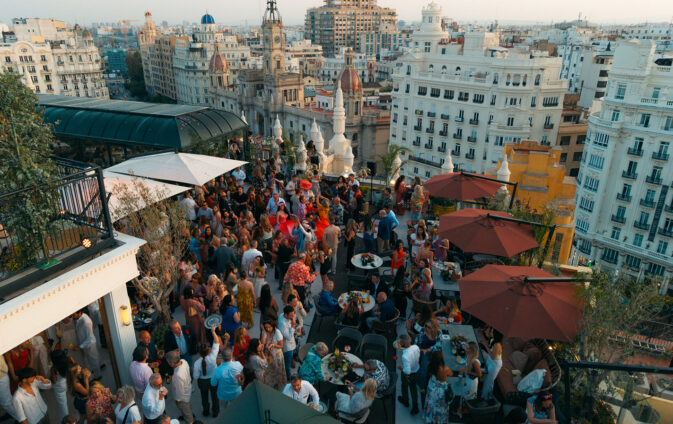
Over the years, the project has received recognition in various key areas that reflect its holistic approach. Among these, the awards won by Atenea Sky stand out, reinforcing its position as one of the city’s most iconic venues:
- Levante-EMV Tourism Award in the Leisure and Gastronomy category, for its contribution to promoting Valencia as a destination
- Hospitality Design Award from the Valencia Hospitality Federation, recognising the architectural work and integration of the space
- Mentions and accolades in international guides such as Repsol and The New York Times.
In addition to these accolades, Grupo El Alto has received the Valencia Hospitality Award for Professional Achievement, cementing the group’s standing within the sector, as well as sustainability certifications that reinforce its commitment to a responsible business model.
At the same time, its venues have consistently won awards. Estates such as Masía Aldamar and La Barraca del Palmar have been recognised in various editions of the Wedding Awards, highlighting their uniqueness and ability to create distinctive experiences.
This recognition extends to the media sphere as well, with coverage in the specialist press and the backing of key figures in the Valencian gastronomic sector, consolidating an offering that combines experience, innovation and a strong connection to the local area.
ABOUT VALENCIA BEST PLACES
his project grows from the land and evolves with it.
Every Kitchen Garden in production, every restored estate and every dish served form part of a single way of understanding Valencia: from its origins, with respect and a connection to the environment.
It is within this context that Valencia Best Places was born, an initiative that brings together unique spaces united by a shared vision: to showcase Valencia through its land, its produce and its experiences.
Restaurants, estates and unique venues that offer not just fine dining, but a way to experience the destination from within. Added to this is a programme that integrates
culture and leisure as a natural part of the project: musical events, artistic interventions, gatherings and experiences that bring the spaces to life and connect them with the city’s daily rhythm.
From the city centre to the orchards and the sea, each place allows you to discover a different side of Valencia. Valencia Best Places thus proposes a model of tourism that celebrates the local, connects visitors with the essence of the region, and transforms every experience into something authentic and memorable.
A journey that is not limited to simply seeing Valencia, but invites you to understand it, savour it and experience it from its very roots.